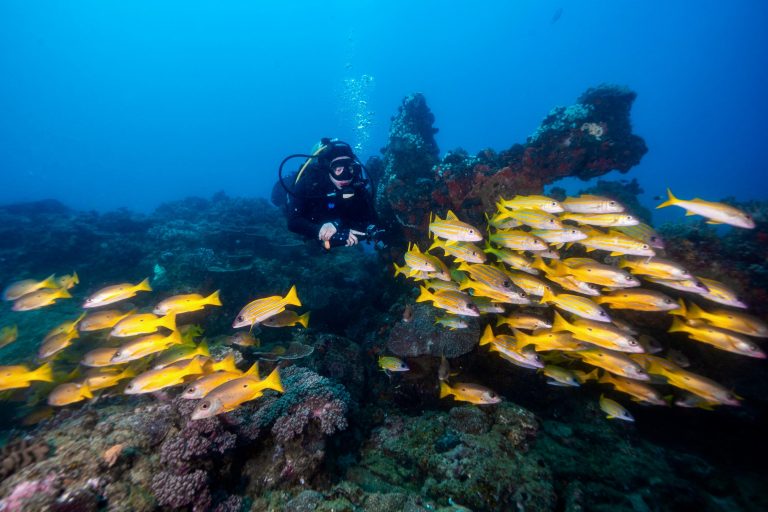
Our world is an ocean planet and hidden beneath the ocean waters, are important coral reef ecosystems that are teeming with life. Have you ever wondered what makes coral reefs so important? Well, the benefits are countless.
Coral reefs, together with ocean plants, provide the ocean with oxygen and contribute to more than 50% of the global oxygen in the atmosphere that we depend on. It also absorbs nearly 30 % of man-made carbon dioxide.
Healthy Corals are the foundation of our ocean’s food chain, from tiny plankton to the largest sea animals. Coral reefs are often called the rainforests of the sea because of the vast number of species they harbour and the high productivity they yield. Aside from the many species of coral, they support extraordinary biodiversity and are home to a multitude of different types of fish, invertebrates, and sea mammals. Covering less than one percent of the ocean floor, reefs support an estimated twenty-five percent of all marine life, with over 4,000 species of fish alone. Reefs provide spawning, nursery, refuge and feeding habitats for many organisms, including sponges, jellyfish, corals, worms, crustaceans, molluscs, octopus, starfish, and turtles.
By providing a suitable environment for fish to thrive, coral reefs are an important contributor to our South African economy through jobs in the fishing industry and food for the population. Their beauty also makes coral reefs a powerful attraction for tourism, and well-managed tourism provides a sustainable means of earning income and employment for people in our area. Thus, healthy coral reefs contribute to providing thousands of jobs along our coastline.
Many of the world’s reefs have already been destroyed or severely damaged; once damaged, it is difficult for these fragile environments to recover. Therefore, it is our duty as locals to safeguard our natural resources.
We are fortunate to have our coral ecosystem within the safe haven of an MPA. Further to that, we as locals create awareness daily by arranging and participating in beach clean-ups, providing education on the protection of our rivers, and not allowing upstream activities to pollute our freshwater system that would eventually discharge into the ocean.
These are facilitated by arranging school field trips for our local youth, creating access to ocean spaces among previously disadvantaged individuals, and teaching conscious diving to our student divers while highlighting the importance of the coral reef ecosystems. We teach our students neutral buoyancy diving at all times “do not touch, do not disturb, and most certainly leave no “fin print.”
by Nasreen Khan